Tuesday, March 2, 2010

2010 Kia Ray Plug-in New Hybrid Concept EcoDynamics

CHICAGO, February 10, 2010 – Kia Motors America (KMA) today unveiled the Ray Plug-in Hybrid concept during a press conference at the 2010 Chicago Auto Show, advancing momentum of Kia Motors' global alternative fuel and powertrain research program, and its sub-brand coined 'EcoDynamics,' to develop innovative fuel-stretching and emissions-cutting technologies. 
 2010 Kia Ray Plug-in New Hybrid Concept EcoDynamics
The most efficient Kia vehicles with significant fuel consumption and emission reductions developed under the EcoDynamics sub-brand will be identified with the EcoDynamics badge. Recently, the EcoDynamics sub-brand took a major step forward with the introduction of the Kia Borrego Fuel Cell Electric Vehicle (FCEV) followed by the Forte LPI Hybrid, the gasoline Kia cee'd Hybrid and the twin-turbo diesel Kia Sorento Hybrid.
 2010 Kia Ray Plug-in New Hybrid Concept EcoDynamics
Kia Ray Plug-in Hybrid Concept is designed in a lowered mono-volume curvaceous shape for improved aerodynamics, while the use of lightweight and eco-friendly recycled materials is what had made it called EcoDynamics. 
 2010 Kia Ray Plug-in New Hybrid Concept EcoDynamics
To support this, the Ray” employs new “cool car” technology, including nano-laminate films and cool-glazing materials to reduce solar heat and demonstrate how keeping the interior cool while reducing air conditioning loads and greenhouse emissions. In addition, The “Ray” interior is also stuffed with eco-friendly recycled materials, which is strengthened by green technology feature of the all-new GreenEdgeTM system by Infinity® Audio.
 2010 Kia Ray Plug-in New Hybrid Concept EcoDynamics
Kia Ray Plug-in Hybrid Concept is powered by an all-aluminum 153-horsepower Gasoline Direct Injection (GDI) 1.4-litre engine mated to a permanently-engaged fixed ratio Continuously Variable Transmission (CVT), which is used in combination with a 78kw electric motor. 
 2010 Kia Ray Plug-in New Hybrid Concept EcoDynamics
To encourage economical driving, the “Ray” is equipped with an engine-power saving alternator management system and a toggle gear-shift indicator. Moreover, the custom-designed low-rolling resistance tyres with a hexagon pattern in narrow 20-inch (195/50R20) construction also contribute to improve efficiency.
 2010 Kia Ray Plug-in New Hybrid Concept EcoDynamics

Monday, March 1, 2010

The future's electric

Well it is according to the UK Government’s Department of Transport. It has launched, via the Office for Low Emission Vehicles (OLEV), a scheme to help with the purchase of electric cars.


The Plug-in Car Grant will cover up to 25% of the vehicle’s price, to a maximum of £5,000, and it’ll be available to both private and business users.


Application of the subsidy is going to work in a similar way to the scrappage scheme: the dealer will simply deduct it from the invoice when the car is bought. No form-filling needed to retrospectively claim the cash.


£230 million has been set aside, so that’s a potential 46,000 electric cars.


The money is due to be available from January 2011, but the rules are strict. Cars will have to fit into one of three categories to qualify:


1. All-electric (electric motor powered by a rechargeable battery)

2. Plug-in hybrid (powered by both mains-rechargeable batteries and an internal combustion engine)

3. Hydrogen fuel cell powered


That means there’s no point in rushing out to your Lexus dealer to order that hybrid RX 450h. You can’t plug it into the mains, so it’s not eligible.


Neither, for the same reason, is the environmentalists’ favourite, the Toyota Prius.


Does that mean that the UK’s most popular plug-in electric vehicle, the Reva G-Wiz, will have OLEV’s cash all to itself? Er, no… it’s not eligible either because it’s classed as a quadricycle, not a car.


Even if the G-Wiz was a car, its performance would rule it out. OLEV is also stipulating that eligible all-electric cars must have a range of at least 70 miles (113 km), and be able to hit 60 mph (96 kph). The G-Wiz fails on both counts, running out of charge at 48 miles and only managing 50 mph flat out.


So that might not leave too much choice. One possible contender is the City from Norwegian firm Think. It has a range of 112 miles (180 km), and can just achieve the magic 60 mph top speed. Like all manufacturers though, Think will first have to apply to the government before being considered for the scheme.


The Nissan Leaf, due for a European launch at the end of this year, could be a major player. Nissan’s Sunderland facility is in the running to build it, and that will be an important factor for some UK consumers when choosing an electric car.


Chevrolet is also scheduled to launch its plug-in hybrid Volt towards the end of 2010, albeit only in North America. UK sales of the right-hand-drive Vauxhall version, the Ampera, won’t however begin until 2012.


Of course, electric cars aren’t much good if they can’t be recharged. To address this, the government has also earmarked £30 million for 11,000 Plugged In Places - or public recharging points in plain English. The only trouble is that these will be restricted initially to London, Milton Keynes and the North East, with only 2,500 being installed in the first year.


Assuming you’ve found an eligible car, and there’s somewhere to recharge the thing, is it really going to be green? It’s the thorny issue of where all that electricity actually comes from.


In the UK, around a third of electricity is generated from coal, with over 40% coming from natural gas. That means roughly only a quarter is produced from non-fossil fuel sources, the bulk of that being nuclear. Only 6% currently comes from renewables.


Nevertheless, the government reckons that all-in-all, an electric car will be responsible for 40% less CO2 than a normal car. But even so, more electric cars won’t significantly reduce the country’s dependence on dwindling fossil fuel stocks, most of which are imported.


In time, achieving the two symbiotic goals of energy self-reliance and true zero emissions vehicles will probably have to mean increased renewables as well as more nuclear power. And the latter is as unpalatable to some as greenhouse gases.


Assuming the Plug-in Car Grant is successful (and who knows whether it’ll survive a potential change in government after this year’s general election) expect a new road safety campaign to be launched shortly afterwards. Otherwise, there’s going to be a lot of people getting run over by all those silent cars.

2010 ENCO Exclusive Audi Q7 3.0 TDI

this is the new 2010 ENCO Exclusive Audi Q7 3.0 TDI picturesna and reviews
Several customizations added by ENCO Exclusive on the Audi Q7 accommodate advanced and aback accent in the appearance of the V12 top model, the behemothic radiator grill, the use of atom lights from the face lift archetypal at the advanced and back, the addition of the caster arches which is distinctively complete to be acclimated calm with the V12 apparatus and the aboriginal S band package,and the ENCO GT beanie fabricated of carbon fibre with congenital blast slits that was covered in a matt atramentous foliation.

The ENCO Q7 additionally has the centralized Jura rims 11×23 inches with the “black chrome” finish, Dunlop SP Sport Maxx tyres 315/25R23 with chicken saddle of a bowl braking system, and stoppers that were crude from a Porsche Cayenne. To add, the lower contour of the Audi Q7 is done by blurred the abeyance ambience bore for the accepted airride system.

In the interior, the Audi Q7 is accomplished with assorted carbon genitalia and it is archetypal for ENCO. The focused colors were acclimated in the dashboard, average console, aperture coverings and in the anew advised sports council wheel.


2010 WTCC points

The FIA has changed the points system for the World Touring Car Championship.


Instead of the top eight finishers scoring (allocated on a 10, 8, 6, 5, 4, 3, 2, 1 basis), the first ten will now be awarded points:


1st: 25 points

2nd: 18 points

3rd: 15 points

4th: 12 points

5th: 10 points

6th: 8 points

7th: 6 points

8th: 4 points

9th: 2 points

10th: 1 point


This brings the WTCC in line with the new system already adopted by F1 and the World Rally Championship for the 2010 season.


The much larger points disparity - especially for the podium positions - is designed to push drivers to battle on, as just one place difference could have a big impact on their overall standing.


Arguably, given the already close racing in touring cars, that’s more applicable to F1 than the WTCC.

Sunday, February 28, 2010

2010 Citroen DS3 Racing Car Limited Edition

Citroen plans to unveil a limited edition of the Citroen DS3 next month at the Geneva Motor Show. The Citroen DS3 Racing is a suped up version of the company's luxe supermini. While only 1000 units will be built, Citroen Australia General Manager, Miles Williams said that local availability for the special DS3 Racing will be announced when the regular DS3 launches in August.
2010 Citroen DS3 Racing Car Limited Edition
“The Citroen DS3 Racing represents an outstanding concentration of behind-the-wheel thrills with an artful blend of performance and efficiency. The DS3 Racing provides a clear indication of what we can expect when the DS3 arrives in Australia in August.” Mr Williams said.
2010 Citroen DS3 Racing Car Limited Edition
Developed by Citroën Racing - the winning team behind five WRC manufacturer's titles and six driver's titles for Sébastien Loeb and Daniel Elena - Citroën DS3 Racing is a special edition with a 100% sporting pedigree. Planned for the second half of 2010, the exclusive Citroën DS3 Racing will be limited to just 1000 production units.
2010 Citroen DS3 Racing Car Limited Edition
As such, the car's output has been bumped up by 30% to 200 PS (147 kW / 197 hp) using the turbocharged 1.6-liter THP engine. Torque is improved by 15% to 275 Nm (203 lb-ft). These changes were achieved by remapping the engine control unit, adjusting the turbo, and adjusting powertrain components.
2010 Citroen DS3 Racing Car Limited Edition
Meanwhile, stiffer suspension springs and new shock absorbers are also installed. The car has been lowered by 15mm, while both the front and rear track were widened by 30mm. Along with the new tires wrapped around the 18-inch wheels, the changes "all dramatically change the driving dynamics," according to a press release.
2010 Citroen DS3 Racing Car Limited Edition
To handle the extra power, the company installed four-piston caliper brakes up front and ventillated discs in back. Carbon-fiber touches are used on the new air diffuser, front bumper, lower body, and wing extensions. Chrome is also used at certain points, like the door handles and exhaust, with orange tint on the calipers, grille, roof, side mirror caps, and wheels. Inside, designers added carbon trim and orange inserts. Purposeful sport seats were also installed.
A Citroën DS3 Racing signature on the rear tailgate and an individually numbered identification plate fixed to the roof-lining further confirm the model's exclusivity.
2010 Citroen DS3 Racing Car Limited Edition
At 3.94-meters long, the grey and orange car will be shown in Geneva with checkered flaq and DS3 Racing graphics. Based on the existing DSport powered by the THP 150, production Citroën DS3 Racing editions will be finished in a special workshop and fitted with a parts kit developed according to Citroën Racing specifications. Only 1000 units of the Citroen DS3 Racing will be produced. The car will be released in the second half of 2010.

Friday, February 26, 2010

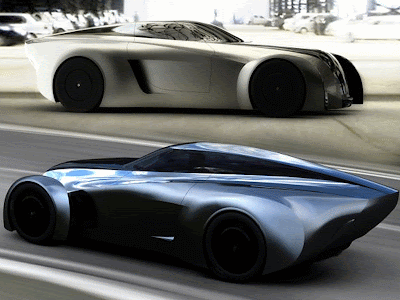
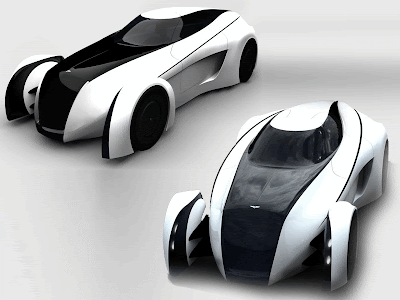
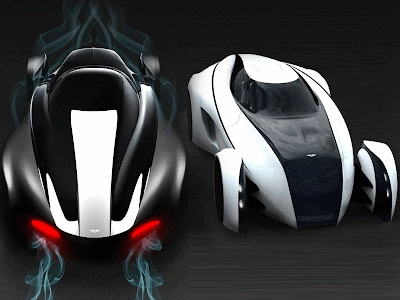
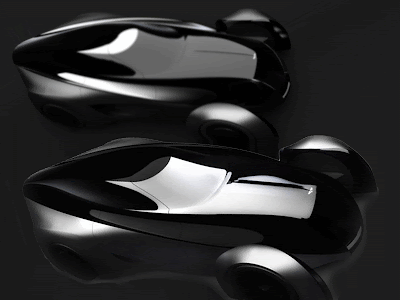
Bentley AERO ACE Sports Car Concept Next-Gen Speed VI

The Bentley Aero Ace Speed VI is the brainchild of auto designer Gabriel Tam and has been inspired by the original Speed 6 driven to victory by the Bentley Boys of the ’20s at Le Mans. The next-generation Speed VI is an overtly sporting vehicle with the raw aggression of a pure blood racer, while retaining the refined elegance of past Bentleys.
Bentley AERO ACE Electric Sports Car Concept Next-Gen Speed VI
The design was inspired to signify the raw aggression of a sporting vehicle, while paying close attention to the aerodynamic properties of each element of the vehicle. The adjustable aerofoil / spoiler feature double wishbone suspension to maximize the efficiency.
Bentley AERO ACE Electric Sports Car Concept Next-Gen Speed VI
Close attention during the designing period to refine the aerodynamic properties of the vehicle has resulted in enhanced efficiency and increased speed. Additionally, a double wishbone suspension has been incorporated within the adjustable spoiler to further better its efficiency.
Bentley AERO ACE Electric Sports Car Concept Next-Gen Speed VI
The twin rear heat exhaust-ducts of this zero-emission concept car are fed by the air intake used to keep electric motors cool. Electric motors are located towards the rear of the vehicle, while the battery cells are located towards the front in an even arrangement to balance the weight. The electric motor cooling system features air intake and incorporates diffusers that help air flow to create down-force.
 
 
Bentley AERO ACE Electric Sports Car Concept Next-Gen Speed VI
The wheels are semi enclosed that improves aerodynamics, while the 1+1 seating arrangement offers focused driving experience. Also, the diffusers aid air flow in this vehicle creates the down-force, the battery pack is equally distributed and the vehicle has a 1+1 seating layout for finest weight distribution.
Bentley AERO ACE Electric Sports Car Concept Next-Gen Speed VI 

Thursday, February 25, 2010

The end of Hummer

BCP6BN34436B


As reported in The Times, the attempt by General Motors to flog its ailing Hummer brand to the Chinese has failed.


Sichuan Tengzhong Heavy Industrial Machinery, with no experience of vehicle manufacture, had agreed to buy Hummer for $150 million. However, the deal needed approval from the Chinese government. They, in the end, weren’t too keen because it didn’t fit in with their nascent green policies.


The chance of finding another buyer appears slim. Of course this is awful news for those working for Hummer and its dealers, but the unfortunate reality is that it’s the free market at work.


Economic meltdown and rising fuel costs have severely affected many people’s wish to buy an SUV. The current need for SUV drivers to withstand the withering looks and snide comments, freely offered by those of an environmentalist bent, hasn’t helped either.


Hummer was hit especially badly, and sales in 2009 fell a massive 67% to around 9,000 units. Its products had become largely irrelevant. Hardly anyone needed the range’s off road ability, and one of the few unconvincing concessions to improved fuel consumption was the availability of a 3.7 litre five cylinder engine for the H3 (instead of the usual 5.3 litre V8). Petrol-powered, of course - no diesels here.


The vehicle that started it all, the military-spec Humvee, is unaffected by the demise of Hummer and will continue to be built by AM General.