Thursday, February 24, 2011
Mazda MX-5 Kendo
Sometimes it feels like a large proportion of those have been special editions, so there are no prizes for guessing how Mazda has decided to mark that production milestone. Yes, it has cobbled together yet another special edition.
This one is called the ‘Kendo Special Edition’, named after the modern Japanese martial art. On sale in the UK from the beginning of March, buyers will be able to choose from either the £19,255 MX-5 1.8i Kendo soft-top or the £22,320 Mazda MX-5 2.0i Kendo roadster coupe.
The formula used is tried and tested: Paint the car a different colour, stick some fancy trim on the seats, add a few options.
In the case of the Kendo - which is based on the current SE models - this means Sparkling Black or Dolphin Grey mica finishes for the bodywork, while the interior gets Stone Leather upholstery.
Also included are unique 17” alloy wheels, cruise control, Bluetooth telephone connectivity and a Bose audio system. Finishing things off are heated seats, brushed aluminium trim, front fog lights, aluminium pedals, floor mats and special badges.
Related post:
Mazda MX-5 Miyako
Wednesday, December 1, 2010
BBR gives MX-5 235 bhp
For those who think that that’s not enough, tuner BBR has got together with Cosworth Engineering to provide a fix.
Their solution is to attach a fourth generation Eaton MP62 supercharger, which lifts power by almost 50% to 235 bhp (175 kW / 238 PS), while torque rises from 188 Nm (138 lb/ft) to 257 Nm (190 lb/ft). That puts the BBR-Cosworth MX-5 right on a par with competitors such as the £33,870 Mercedes-Benz SLK 300.
However, the conversion consists of more than just the supercharger. To help the engine breathe better, a Cosworth inlet manifold housing is fitted, together with high-flow calibrated injectors, air box and air filter.
Managing everything is a BBR Auxiliary Interceptor 2010 engine control unit, which has 3-D mapping and a MAP sensor. An air to water intercooler is also included in the package, and competition-grade hoses and fixings are used throughout.
The finishing touches are the BBR-Cosworth identification badges, which are the only external clue to the under-bonnet transformation.
The BBR-Cosworth Mazda MX-5 supercharger upgrade is priced at £4,995.00, including installation by BBR. Kits will also be made available for DIY fitting.
Monday, September 13, 2010
2010 Mazda Sport Cars Coupe Shinari Concept Car


2010 Mazda Sport Cars Coupe Shinari Concept Car
Wednesday, June 30, 2010
Mazda MX-5 Miyako
So what are the differences? Well, the 20th Anniversary Limited Edition is available only as a soft top, powered by the 124 bhp (92 kW / 126 PS) 1.8 litre engine. Costing £17,300 on the road, its specification includes unique finish 17" alloy wheels, front fog lights, a strut brace, individually numbered Limited Edition scuff plates, special floor mats, body-coloured dashboard decoration panel, aluminium pedals, manual air con, leather steering wheel, gear knob and handbrake lever. Paint choices are Aurora Blue, True Red and Crystal White Pearlescent.
Similarly, the Miyako special edition also features 17" alloy wheels, front fog lights, a strut brace, and special floor mats. Additionally, though, it gets unique Medici premium perforated black leather trim with a red underlay and stitching, climate control air con and the obligatory special badging.
Unsurprisingly, the extra equipment makes it a bit more expensive than the 20th Anniversary Limited Edition. Mazda is charging £18,385 for the 1.8i Miyako soft top, which comes in either Aluminium Silver Metallic or Velocity Red Mica.
For the first time, a special edition of the MX-5 is also available as a roadster coupe (the one with the folding powered roof). However, that version of the Miyako can only be had with the 157 bhp (117 kW / 160 PS) 2.0 litre engine, and it costs £20,885. Colour choice is restricted to just Aluminium Silver Metallic.
To put those prices into context, a standard 1.8i SE soft top with air con is £17,795, while the 2.0i SE roadster coupe would set you back £20,295. Given that leather trim and metallic paint alone come to £1,115 on the Mazda options list, the £590 premium being charged for the Miyako looks like good value.
The MX-5 Miyako special edition is on sale from the beginning of July, with 500 examples of each version being produced for the UK market. And, in case you were wondering, they are named after the Japanese holiday island of Miyako-jima.
Friday, April 16, 2010
The end of the RX-8
Euro 5 further reduces the permitted amounts of carbon monoxide, hydrocarbons, oxides of nitrogen and particulate matter in car and light commercial exhaust gasses. The stricter standards came into force across the European Union for newly-launched models in September 2009, and will apply to all cars on sale (regardless of their original introduction dates) from January 2011.
The problem for the RX-8 was its rotary engine. Although powerful, generating 228 bhp in its final guise, it was awfully inefficient. For example, combined cycle fuel consumption was a fairly pathetic 24.6 mpg, while CO2 emissions were 299 g/km. By comparison, a BMW 330i Coupe with 272 bhp manages 38.9 mpg and 173 g/km.
Mazda could have modified the RX-8 to be Euro 5 compliant, but the company soon realised the cost and effort involved didn’t make that option worthwhile.
But this doesn’t mean the end of rotary engines altogether. Mazda is going to persevere with the technology, and is currently working on a replacement for the RX-8. It’ll need to ensure that model’s emissions comply not only with Euro 5, but also with the even tighter Euro 6 rules that come into force from September 2014. Hopefully the fuel consumption will improve a bit, too.
Tuesday, March 9, 2010
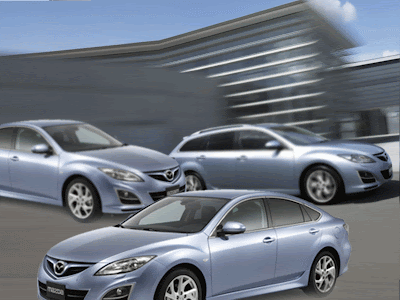
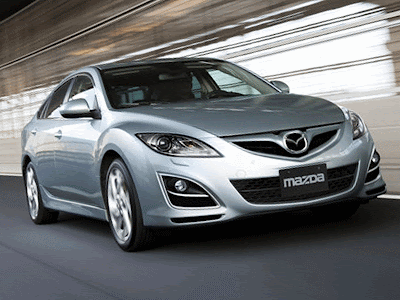
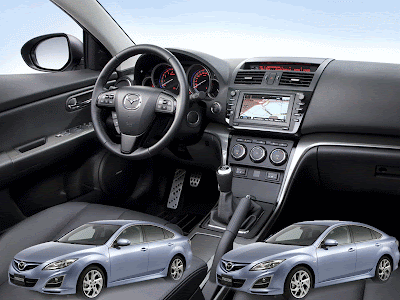
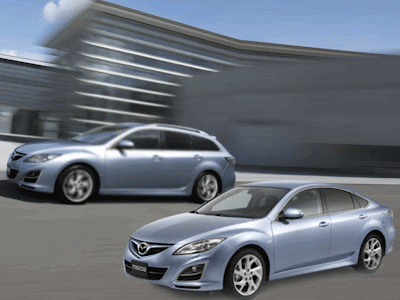
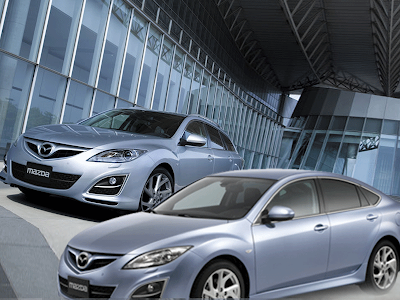
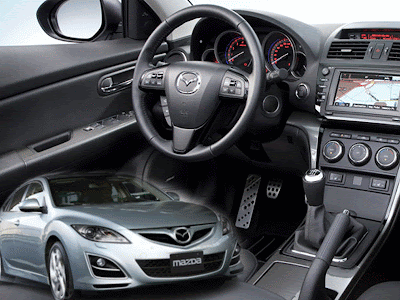
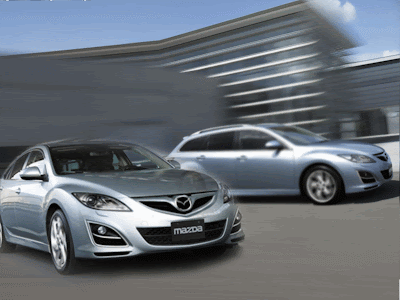
2011 Mazda Sports Car Mazda6 Facelift


Saturday, January 2, 2010
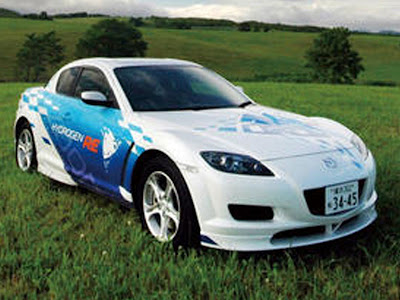
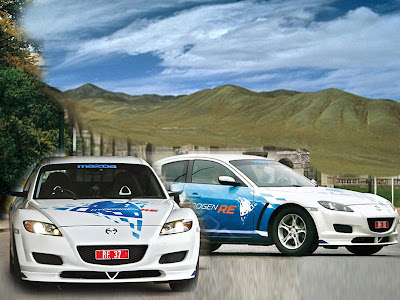
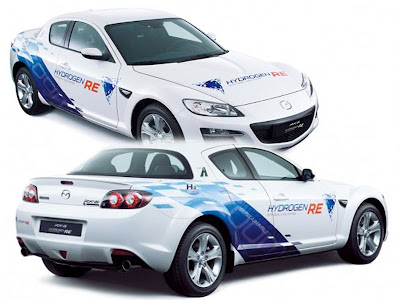
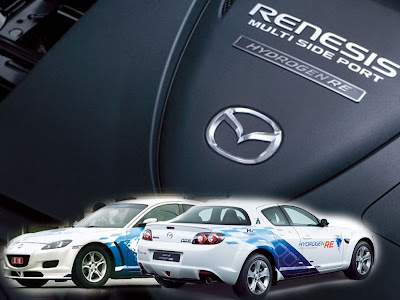
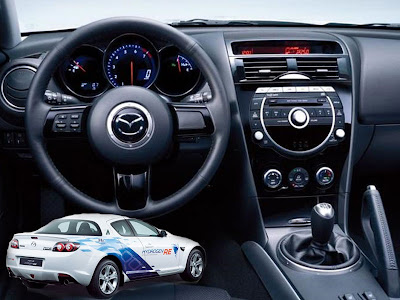
2009 Mazda Sports Car RX-8 Hydrogen RE vehicle with Norwegian specifications in HyNor
2009 Japan Mazda Motor Corporation (HIROSHIMA) announced that it has built the first Mazda RX-8 Hydrogen RE vehicle with Norwegian specifications, developed specifically for participation in HyNor, Norway’s national hydrogen project. The first unit will take part in ceremonies marking the official opening of HyNor’s hydrogen filling stations.
Unlike the RX-8 Hydrogen RE currently being leased in Japan, the HyNor-specification Mazda RX-8 Hydrogen RE is based on the latest European-specification Mazda RX-8 with left-hand drive and a manual transmission.
The HyNor project aims to enable hydrogen vehicles to travel along a 580-kilometer stretch of highway by establishing a chain of hydrogen stations between Stavanger and Oslo in Norway.
Mazda agreed to collaborate with HyNor on the project in November 2007 and began validation of the RX-8 Hydrogen RE’s driving performance on Norwegian public roads in October 2008.
Wednesday, November 11, 2009
Mazda RX-Z Concept 3.0 litre V6 and two electric motors Sports Car Coupe.
The Mazda RX-Z concept is a proposal for a 2+2 sports coupe to replace the aging Mazda RX-8. The design was conceived by Andrus Ciprian, a design student from Romania whose previous work includes the Dacia MC concept. Like the MC the RX-Z concept was created using the 3d modeling program 3D Studio Max, and rendered with the help of Mental Ray.
Mazda RX-Z Concept Sports Car Coupe The RX-Z was developed as Ciprian puts it; "as a link between fossil fuel cars and more ecological ones." To achieve this the proposed drivetrain for the concept includes a 3.0 litre V6 diesel engine up front - which replaces the notoriously thirsty rotary engine from the RX-8. And a pair of electric motors at the rear. Under normal conditions the RX-Z would be driven solely by the diesel engine. But at low speeds around town the electric drive can be used on its own for emission free motoring. At higher speeds the electric motors work in conjunction with the V6 engine to provide a boost function. A start/stop technology which is integrated into the engine further increases fuel efficiency.
Mazda RX-Z Concept Sports Car Coupe One of the more unusual features of the Mazda RX-Z concept is the rear light panel. In the middle is a display screen which can light up with any text written by the driver. Presumably you can only 'write' on the back of your car when stopped, otherwise this would be one surefire way of either getting in a crash or getting in trouble!
Wednesday, October 7, 2009
Sky Concept The Mazda 2010 Featuring the next-generation Mazda SKY concept powertrain technologies and comprehensive advancements in weight reduction
To make its Japan debut * Mazda Kiyora concept car, which achieves 3.1 l/100 km fuel economy.
Mazda’s theme for the 2009 Tokyo Motor Show is “The Mazda SKY concept – Providing driving pleasure and environmental and safety features for all customers!” Under the headings of “Today,” “Tomorrow” and “The Future,” Mazda will display advanced technologies designed to improve the average fuel economy of Mazda vehicles sold globally by 30 percent before 2015 compared to 2008 levels. This is one of the goals of Mazda’s long-term vision for technology development, Sustainable Zoom-Zoom.
The SKY concept embodies Mazda’s desire to ensure an “everlasting blue sky” under which drivers will always be able to enjoy the pleasure of driving afforded by owning a Mazda. The concept also reflects the “sky’s the limit” aspirations of Mazda’s engineers as they employ unconventional thinking to achieve optimal performance in every vehicle that bears the Mazda nameplate.
Mazda is committed to significantly improving the core aspects of its vehicles that affect performance – engines, transmissions, and lighter vehicle weight – in order to achieve elevated driving pleasure together with outstanding environmental and safety features. The Mazda SKY concept defines Mazda’s approach to developing next-generation powertrains that will significantly improve the eco-friendliness and dynamic performance of all Mazda vehicles.
Based on the SKY concept, Mazda’s “Technologies for Tomorrow” display at this year’s Tokyo Motor Show will include the next-generation direct-injection petrol Mazda SKY-G engine and the Mazda SKY-D clean diesel engine. Both offer improved eco-friendliness and torque thanks to optimised combustion efficiency. Mazda will also reveal its first next-generation automatic transmission, the Mazda SKY-Drive, which offers first-rate fuel economy and a direct driving performance feel
Alongside the SKY concept exhibits, Mazda will also feature a “Today’s Technologies” exhibit that includes i-stop, a unique idling stop system that was introduced with the all-new Mazda3 (Axela in Japan). “Future Technologies” will showcase the advanced Mazda Premacy Hydrogen RE Hybrid, with its hydrogen-powered rotary engine, and various vehicle technologies under development as part of Mazda’s drive to realise an accident-free and safe motorised society.
Thursday, October 1, 2009
Mazda MX-5 Roadster Sport Concept Car
Mazda Superlight equipped with a standard four-turbocharged engine of 1.8 liter capacity 126 hp, maximum torque is equal to 166 Nm. Acceleration 0-100 km / h in 9.2 seconds with the concept. Roadster received 17-inch wheels with tires of dimension 205/45, Bilstein shock absorbers and springs Eibach.
Thursday, July 9, 2009
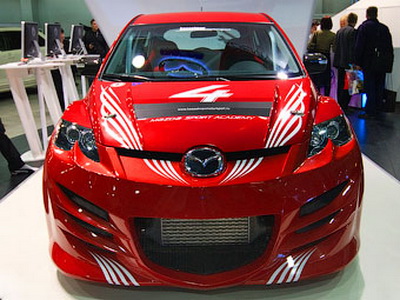
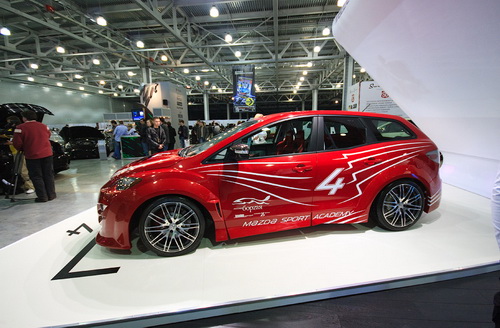
Mazda has developed a sports off-road car

From serial the car "Russian Fleet" differs easier body — developers managed to lower weight of a crossover with 1800 to 1500 kgs, and also the developed aerodynamic weather-cloth which increases clamping force by 10 percent. The four-cylinder turbo-engine in volume on this car develops of 2,3 litres power in 400 horsepowers, and the twisting moment has grown with 350 to 588 Nanometers. A transmission — mechanical, from European version CX-7.

Besides the powerful motor, racing version CX-7 is completed by a professional adjustable suspension bracket with the road gleam reduced on 70 millimetres, more effective brakes with disks in diameter of 355 millimetres, the strengthened coupling and a back reducer, and also intellectual electronics. In an interior from the serial car there was only a forward panel, and that in seriously modernised kind, instead of back seats there was specially developed skeleton of safety, and lobbies have replaced with "ladles".
Tuesday, June 16, 2009
Mazda: special series AZ-Wagon
Japanese company Mazda has prepared for sales on home market special version Mazda AZ-Wagon.
The car is practically copy Suzuki Wagon R. Anything essentially new in the car is not present. The special version differs such small details, as lateral mirrors with repeaters of indexes of the turn, the chromeplated details of an interior, an automatic climate the control and a leather braid of a steering wheel.Monday, April 27, 2009
Mazda RE-Amemiya Genki 7
Isami Amemiya founded RE Amemiya Car Company in Chiba, Japan way back in 1974. The tuning company has been specialising in the modification of cars fitted with the rotary engine. For a long time these have been exclusively Mazda RX-7s. At this year's Tokyo Auto Salon RE Amemiya presents the Genki7. The Genki7 is built from an RX-7 and it apparently features an engine tuned by long-time RE Amemiya collaborator GReddy. No numbers were tossed alongside the pictures apart from the claim that the engine will help the Genki7 "leave everyone behind".
Thursday, April 10, 2008
Mazda 3 MPS Rally Car Revealed (AU)
Mazda's rally history may not be as rich as some other Japanese marques, but Mazda Australia is more than willing to set the record straight. For their eighth Targa Tasmania excursion, held from April 15-20, Mazda will use a brand new Mazda3 MPS rally car. Mazda Motorsport chief Allan Horsley heads the team consisting of Rick Bates and Alister McRae and their co-drivers who will compete in the 2WD Showroom competition. Targa Tasmania rules state that the rally cars must be mostly standard, meaning that drivers will compete in cars featuring audio systems, electric windows and carpets and upholstery in tact. Additional safety equipment (roll-cage, five-point harness and fire extinguishers), as well as navigation equipment and extra brake ventilation, is fitted of course.
"The team learned a lot from last year's event," says Bates. "With one Targa in the Mazda3 MPS under our belts we're all a lot more educated in terms of vehicle preparation and conservation during the event." The Targa Tasmania covers 2,000 km over five days of competition.
The Mazda 3 MPS rally car is powered by a 2.3 liter direct injection, turbocharged 4-cylinder engine producing 190kW (255 hp) with 380 Nm of torque and is coupled to a six-speed manual. It weighs 1403 kg and uses 320mm ventilated brakes in front and 280 solid discs in the rear.
Press release:
Mazda Australia today whipped the covers off its brand new Mazda3 MPS rally car ahead of its motorsport debut at next week's Targa Tasmania.
Australia's top-selling importer will unleash two Mazda3 MPS rally cars on the country's pre-eminent tarmac endurance event, held from April 15-20. Professional rally drivers Rick Bates and Alister McRae will spearhead the company's eighth Targa campaign.
Built under the watchful eye of Mazda Motorsport chief Allan Horsley, the 190kW Mazda3 MPS front-wheel-drive hot hatches will contest the event's 2WD Showroom competition, travelling 2000km over five gruelling days of competition.
The team's preparation for the rally commenced this week with Bates, McRae and co-drivers arriving in Tasmania to survey the course. Before the event starts next Tuesday both Bates and McRae will have driven all the daunting stages twice.
"Reconnaissance is the most important part of any rally," says Targa first-timer McRae. "It allows us to focus on when we will need to drive flat out and where it will be possible to conserve the car and tyres."
Team mate Rick Bates is lining up for his sixth assault on Targa. He's on a mission to better his 2007 result - an outstanding 10th outright - and says he's got the equipment and the knowledge to do it.
"The team learnt a lot from last year's event," says Bates. "With one Targa in the Mazda3 MPS under our belts we're all a lot more educated in terms of vehicle preparation and conservation during the event."
"Personally, I'm feeling more confident behind the wheel now that I've spent more time in the car. I have a better understanding of exactly how the Mazda3 MPS handles Targa's tricky and changing road conditions."
Ready the Targa Army
Targa Tasmania's racing regulations require that the Mazda3 MPS rally car remain essentially standard. That means both Mazda3 MPS race cars will compete with standard audio equipment, power windows and carpets and upholstery intact.
Suspension springs, shock absorbers, brake pads, seats, belts and the steering wheel have been replaced. A PCD roll cage, racing seats with five-point safety harnesses, fire extinguishers and navigating equipment have been added for competition.
Additional ventilation is allowed to the brake discs of the Mazda3 MPS, and mufflers and the Powertrain Control Module (PCM) may also be modified. Catalytic converters must remain standard. The engine, gearbox, differential and drivetrain are also standard.
Monday, January 14, 2008
Mazda Furai Debuts in Detroit
The Mazda Furai concept car which makes its world premiere at the NAIAS in Detroit, Michigan, today (Sunday), celebrates 40 years of Mazda’s rotary engine and international motorsports heritage. The raciest interpretation of NAGARE design language to-date, Furai is the latest car in Mazda’s award-winning and highly acclaimed series of concept cars. Nagare (pronounced ‘na-ga-reh’), is the Japanese for ‘flow’ and the ‘embodiment of motion’. Furai (pronounced ‘foo-rye’ – Japanese for ‘sound of the wind’) is the sort of car that could only come from a company that incorporates the ‘Soul of a Sports Car’ into everything it builds, but with an eye toward the future and the environment through the use of renewable fuels. Consequently, Furai is initially tuned to operate on 100 per cent ethanol, while research with partner BP into other future fuels, including ethanol/gasoline blends like E10, continues.
On any given weekend, there are more Mazdas and Mazda-powered cars road-raced in North America than any other brand of car. This is because every Mazda sedan, coupe and sports car really is developed with the highest possible dose of the company’s trademark Zoom-Zoom responsive performance and handling – truly the ‘Emotion of Motion’.
However, Zoom-Zoom is about more than simply vehicle performance. The look and style that is Zoom-Zoom can best be seen in previous NAGARE-based design studies, including the Mazda Nagare concept that debuted at Los Angeles in 2006; Mazda Ryuga (first shown a year ago in Detroit), Mazda Hakaze (which appeared in Geneva last year) and Mazda Taiki – the star of the 2007 Tokyo Motor Show.
The ‘Nagare’ ethos is how Mazda’s future production models will sustain the Zoom-Zoom spirit by exhibiting their strong affinity for motion.
Manufacturers commonly showcase concept cars and design studies with little or no intention of actually using the theme presented. Mazda’s approach is the opposite: all of the Nagare concepts, including Furai, help evolve this evocative surface language for future use. Nagare is how this celebration of motion will be portrayed on interior and exterior surfaces in future models. Instead of form following function, the two merge as one.
Franz von Holzhausen, Mazda North American Operations’ (MNAO) Director of Design and the person who led the team that created the Furai, explains the thinking behind the concept, “We were looking for a way to bridge the gap between Mazda Motorsports and the production vehicles in our lineup. The mindsets of road-car and racing car fans are quite different, so the purpose of Furai is to find a meeting point for these disparate interests.
“Furai achieves this by purposely blurring boundaries that have traditionally distinguished the street from the track. Historically, there has been a gap between single-purpose racecars and street-legal performance models — commonly called supercars — that emulate the real racers on the road. Track cars are, by their competitive nature, ill-suited for practical highway use, as well as generally far from road-legal. While some supercars visit the track on occasion, they are primarily road cars not properly equipped for racing. The aim of Furai is to bridge this gap,” continued von Holzhausen.
However, Mazda neither intends to race Furai, nor is it a supercar the company plans to build and sell in the near future. Rather, Furai is a design study that lives between those extremes. Without the restrictions imposed by serial production models, and with the freedom of an autoshow environment, Mazda is using the opportunity to evolve the company’s Nagare design theme one more step closer to reality.
Instead of mimicking racecar components and design elements in a road car – the strategy preferred by supercar manufacturers – the ‘Mazda way’ was to begin this project with the real McCoy: a Courage C65 chassis that earned its stripes during two seasons of LMP-2 endurance racing in the American Le Mans Series (ALMS). This sports car was successfully campaigned under the MAZDASPEED Motorsports Development banner by B-K Motorsports during the 2005 and 2006 seasons. Drivers Jamie Bach, Guy Cosmo, Elliott Forbes-Robinson, and Raphael Matos piloted the car to one victory and a total of nine podium finishes in 15 ALMS events. B-K finished third in championship standings both years; while Bach and Cosmo were co-Rookies of the Year in 2005 after their first season of ALMS racing.
“Anticipating future rules changes in the ALMS, we created a new closed cockpit which would be more appropriate for a future production model,” said von Holzhausen. “The major element we did not change is the 450-horsepower RENESIS-based R20B three-rotor rotary engine that provides the Furai’s ample Zoom-Zoom. The ultimate Mazda in our minds is rotary powered; as a company, we have no intention of abandoning that valuable asset. When people think of the very best production sports cars in the world, the rotary powered Mazda RX-7 is always on that list.”
The Furai concept serves as a turning point in the Nagare developmental process. While the four previous concept cars explored different ways to express Mazda’s emerging design philosophy and to explore an aesthetic, this one is all about function – every last texture and detail serves some functional purpose. In essence, the Furai creative process boiled down to guiding air over and through the body in fruitful ways. To prove that this concept goes far beyond static aerodynamic analysis, Mazda’s design, motorsports and R&D teams worked together to construct Furai as a 180 mph rolling laboratory to demonstrate its functional capabilities on demand.
“The basic proportions of contemporary race cars are every designer’s dream,” enthused von Holzhausen. “Furai is less than 40 inches high (1000mm) but nearly 80 inches (2000mm) wide.”
While Furai strikes an incredibly strong presence, the real beauty of the project – and it’s most valuable asset as a real-world test-bed – is in the details that von Holzhausen and his team incorporated:
-
The body surface provides ample opportunity to feature core design elements such as aggressive headlamps and Mazda’s unique five-point grille.
-
The headlamp trim pieces function as guide frames to help cancel aerodynamic lift.
-
High-pressure zones just above the front wheels are relieved to serve the same end.
-
The air flow package takes air moving under the front of the car and guides it inside the body to the engine-cooling radiators.
-
Nagare textures incorporated in the side surfaces feed air to the rear brakes, the oil cooler and the transmission cooler.
-
An under-car diffuser that begins rising aft of the cockpit helps draw the volume of air flowing through the radiators and engine bay, out the rear.
The Mazda design and R&D teams worked closely with Swift Engineering to refine the aerodynamic characteristics, assuring that Furai remains glued to the ground at high speeds. Through its existing relationship with Swift Engineering, forged through development of the Mazda/Cosworth-powered Champ Car Atlantic single-seater chassis, the team used complex Computational Fluid Dynamics (CFD) software to tune various Nagare design elements to function at a high degree of efficiency. Drag, downforce, lift and overall aesthetics were all key considerations.
Sourced straight from the race track, the Courage carbon-composite tub is essentially intact under the new Furai body, including the right-side driver’s seat. Instead of the stark interior typical of race cars though, this cockpit is finished with more comfortable but still highly functional surfaces. An electronic display screen and gear-change shift paddles are built into the steering wheel.
In the chassis’ original racing configuration, the passenger seat is filled with electronic gear, so those components were relocated elsewhere to provide adequate space for two occupants. The greenhouse is somewhat wider than the original cockpit to provide adequate head and shoulder room and adequate visibility. Doors attached with butterfly hinges provide a very efficient means of entering the cockpit. In this instance, the design team followed an approach that has proven very effective during years of endurance racing.
“One thing we learned from CFD studies is that we don’t need much rear wing to balance the down force created by the front splitter and the Nagare features we’ve sculpted into the body,” observed von Holzhausen. “Combustion air is provided by a variation of the Turbo Tongue device that Swift developed for Indy car use a decade ago. It rises slightly higher than the surrounding roof surface to ingest clean air above the boundary layer. Our final design works so well that we applied for a joint patent with Swift. Of course, it helps that it’s a real piece of art, too, and one we had to incorporate into the design.”
The Irvine, California-based Aria Group was responsible for creating new composite panels and they worked hand-in-hand with Mazda North American Operations’ own in-house fabrication team to mate them to the Courage chassis. The dark matte finish with red and orange accents harkens back to the livery worn by Mazda’s legendary 787B when it won the Le Mans 24 Hours in 1991, making the company the first – and still only – Japanese company to ever win the endurance classic.
Furai not only probes future design possibilities, it also ventures ahead with an alternative fuel. Consistent with the Mazda’s recently announced ‘Sustainable Zoom-Zoom’ initiatives, the Furai’s three-rotor powerplant has been tuned to run powerfully on 100-percent ethanol (ethyl alcohol) and ethanol/gasoline blends. There are exciting advances being made in renewable fuels, from current blends like E10 (10% ethanol/90% gasoline) with research ongoing into making ethanol from cellulostic materials, to future renewable gasoline components like Butanol – a ‘higher order’ alcohol which is fungible with gasoline.
John Doonan, Mazda’s manager of motorsports team development in the USA, explains the thinking behind Furai’s use of alternative fuel, “One of our key technical partners in motorsports, BP, helped facilitate our use of E100. In 2007, ALMS required use of E10 and E100 is now the only acceptable fuel in the Indy Racing League, so we’re projecting ahead with this application to gain experience and to improve Mazda’s environmental profile.
We are proud to partner BP which is a string leader in renewable fuels and recently announced a US$500 million investment in the Energy Biosciences Institute. BP also has a very green focus in the marketplace, and it’s Mazda’s intention to sustain its Zoom-Zoom performance image on and off the racetrack. While Mazda’s rotary has proven readily adaptable to various alternative fuels, including considerable work with hydrogen fuel, this is the first time it’s been engineered for other ethanol blends. The Mazda rotary engine is unique in its ability to run well on multiple fuels.”
Thursday, January 10, 2008
Mazda RX-8 RS Facelift Photos Released (JA)
The facelifted Mazda RX-8 will be on show at the Detroit Auto Show (starting this Sunday) but this Friday the sportier Mazda RX-8 RS, also facelifted, will make its appearance at the Tokyo Auto Salon. Ahead of that show Mazda has released two images. Mazda released no accompanying text so official specs will remain under wraps until the press conference in Tokyo tomorrow. What we can say is that the facelift comprises of new, sharper and sportier front fascia. The air-intakes have grown on each side of the five-point grille, and the foglights which are incororated there are smaller and no longer round.
At the bottom of the new bumper we see a splitter with small flaps which increase stability and the airflow to the wheels and brakes. Also the RX-8 RS sits on 19 inch wheels and features a rear spoiler, neither of which is likely to make it to the regular RX-8 facelift.
The revised RX-8 is mainly meant for the US and Japan, but Europe may still see the new RX-8 in showrooms.
Monday, December 17, 2007
Mazda CX-7 Adrenaline

Mazda at the Specialty Equipment Market Association's (SEMA) annual show in Las Vegas unveiled CX-7 Adrenaline — a fully running prototype designed to showcase Mazda's "commitment to performance." The SUV has been upgraded to give it sports car-like handling and performance. Mazda engineers converted the CX-7’s stock six-speed automatic transmission to a six-speed manual from the Mazda 6. Adrenaline pushes out more than 300 horsepower, thanks to a re-tuned engine with a modified intake system, header with a free-flow exhaust and more boost from the re-plumped turbo.
A wider, lower stance and a bolder face give the all-wheel-drive Adrenaline an aggressive stance. Unique design cues include new front and rear exterior styling, a clam shell front clip, wrap around rear spoiler and an innovative rear glass design. New fenders and doors give Adrenaline a three-inch wider overall stance. Wheel wells are filled out through the fitment of 22-inch EXE wheels with matching Yokohama tires.